
Mediation In Texas
Whether you are the injured party (plaintiff) or the party being sued (defendant or insurer), understanding how mediation works — and how to approach it strategically — can significantly influence the outcome of your case.
Please read this page carefully and bring your questions to your attorney before your scheduled mediation date.
Legal Framework:
The Texas ADR Procedures Act
Mediation in Texas is governed primarily by Chapter 154 of the Texas Civil Practice and Remedies Code, commonly known as the Alternative Dispute Resolution (ADR) Procedures Act. This statute authorizes courts to refer disputed civil matters — including personal injury cases — to mediation and other ADR processes.
Texas Rules of Civil Procedure — Rule 169 & Related Rules
The Texas Rules of Civil Procedure (TRCP) complement the ADR Act. Rule 169 governs expedited actions (cases worth $250,000 or less), and local district court rules in most Texas counties have adopted standing ADR orders that routinely require mediation before trial settings.
Key Statutes & Rules at a Glance
Tex. Civ. Prac. & Rem. Code Ch. 154 — ADR Procedures Act (authorization, confidentiality, enforceability)
TRCP Rule 11 — Written agreements binding only if signed and filed
TRCP Rule 169 — Expedited actions track (≤ $250,000)
Local District Court Rules — County-specific standing mediation orders (e.g., Bexar, Harris, Dallas, Travis counties)
Tex. Civ. Prac. & Rem. Code § 154.073 — Confidentiality of mediation communications
Court-Ordered vs. Agreed Mediation
Mediation may arise in two ways:
Court-Ordered Mediation: The court issues an order referring the case to mediation, typically as part of a scheduling order or at a hearing. Attendance is mandatory.
Agreed Mediation: The parties and their attorneys voluntarily agree to mediate, often before the court requires it. Many experienced practitioners prefer this approach because it allows greater control over timing and mediator selection.
Confidentiality Protections
One of the most important features of Texas mediation is its broad confidentiality shield under Section 154.073. As a general rule:
All communications made during mediation are confidential and may not be disclosed.
Mediation communications are not admissible as evidence in any later court proceeding.
Neither party may call the mediator as a witness.
There are narrow exceptions (e.g., evidence of criminal conduct, child abuse, or threats of violence), but for the vast majority of personal injury cases, everything said in mediation stays in mediation.
Enforceability of Mediated Settlement Agreements
If the parties reach a settlement, the written and signed agreement is enforceable as a contract under Texas law. Under Section 154.071, a mediated settlement agreement is binding on the parties and is not subject to repudiation by either side. It is critical that you do not sign anything at mediation unless you are ready to be bound.

The Mediation Process:
Understanding what will happen on mediation day removes uncertainty and allows you to focus on the substance of your case.
1) Pre-Mediation Preparation
Before the session, your attorney submits a confidential mediation statement to the mediator summarizing the facts, liability arguments, damages, and your settlement position. This helps the mediator understand the dispute before the parties arrive.
2) Opening Joint Session
All parties and counsel gather in a conference room. The mediator explains the ground rules: confidentiality, voluntary participation, and the mediator’s neutral role. Each side’s attorney may deliver a brief opening statement outlining their position.
3) Private Caucuses (Breakout Sessions)
This is the heart of mediation. The parties separate into private rooms. The mediator shuttles between rooms, conveying offers, gathering information, reality-testing positions, and helping each side understand the risks of going to trial. You are never forced to be in the same room as the other side.
4) Negotiations
Offers and counteroffers are exchanged through the mediator. This process can take several hours. The mediator may share information you authorize or keep it confidential. You control what the mediator discloses.
5) Impasse or Settlement
If a settlement is reached, the parties reconvene and sign a written Mediated Settlement Agreement (MSA). If no agreement is reached, the mediator declares an impasse and the case continues toward trial. Either outcome is a valid result.
6) Post-Mediation Steps
If settled: your attorney will draft the formal settlement documents, release, and agreed judgment or dismissal. If impasse: the court is notified and the scheduling order continues in effect.
Mediation Duration
Most personal injury mediations in Texas District Court last between half a day (4 hours) and a full day (8+ hours). Complex multi-party cases may extend over multiple sessions. Do not expect mediation to be a quick meeting.
Who Attends
Plaintiff and plaintiff’s counsel
Defendant and/or insurance adjuster with full settlement authority
Defense counsel
The mediator
A person with full authority to settle must be present — or available by phone — on behalf of each party. If an insurance company is involved, the adjuster who can approve the settlement must participate. Courts take this requirement seriously.


Mediator Selection:
Qualifications Under Texas Law
Under the ADR Act, mediators in Texas must complete at least 40 hours of training in dispute resolution techniques, including role-playing exercises. Mediators handling family disputes need additional training, but for personal injury cases, the core 40-hour certification is the baseline requirement.
In practice, experienced personal injury mediators typically have legal backgrounds (often former judges or trial attorneys), substantial subject-matter expertise, and hundreds of mediated cases to their credit.
How Mediators Are Selected
The parties and their attorneys typically agree on a mediator. If they cannot agree, the court may appoint one. The selection process usually works as follows:
Each side’s attorney proposes candidates from a list of qualified mediators.
The attorneys compare the candidates’ backgrounds, specializations, reputations, and fees.
A mediator is selected by mutual agreement or, failing that, by the court.
What to Look for in a Mediator:
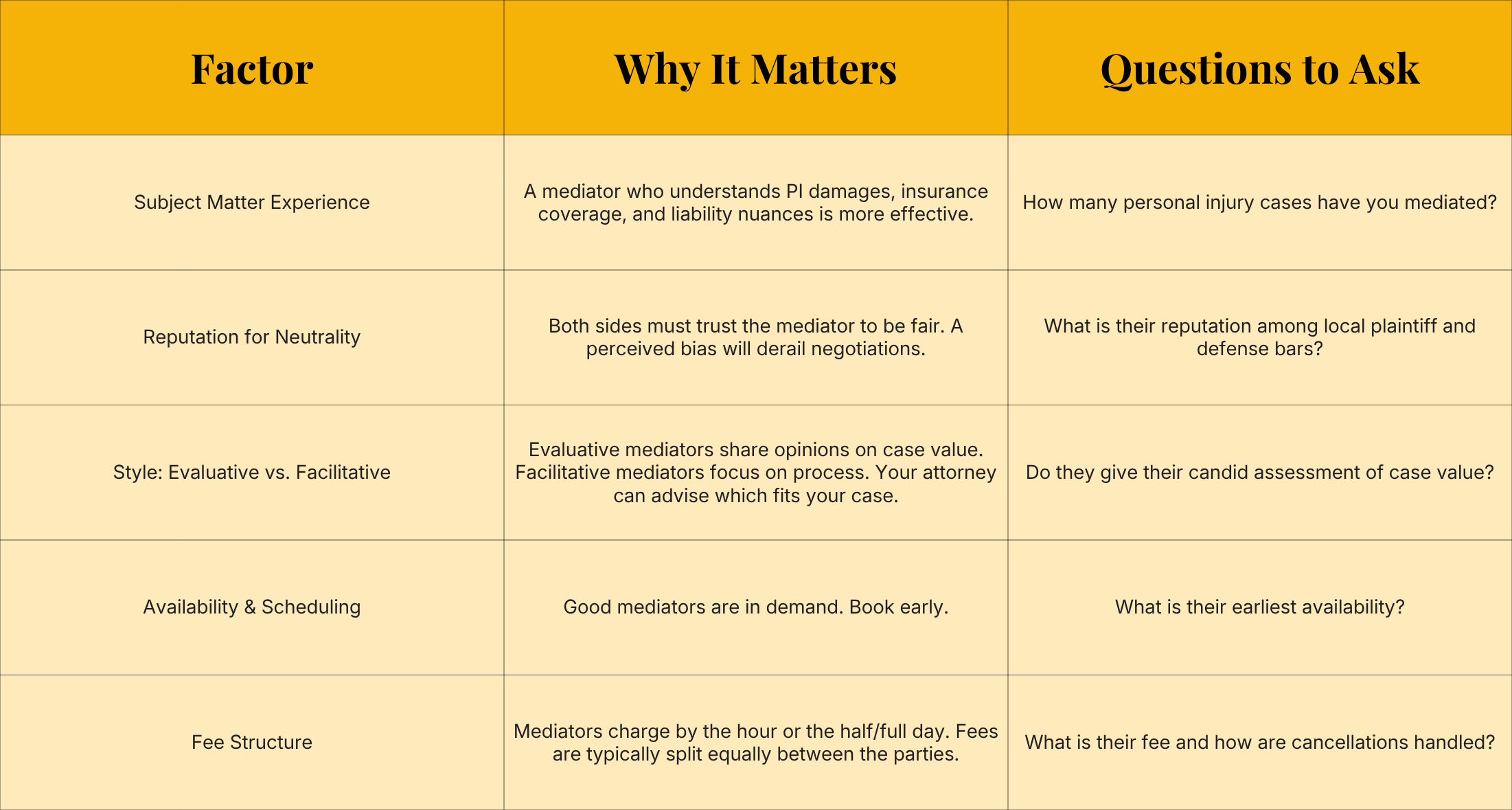
The mediator is not a judge. They have no power to impose a settlement or decide who is right. Their sole function is to facilitate negotiation. If a mediator appears to be pressuring you unfairly or breaching confidentiality, report this to your attorney immediately.
Mediator Fees
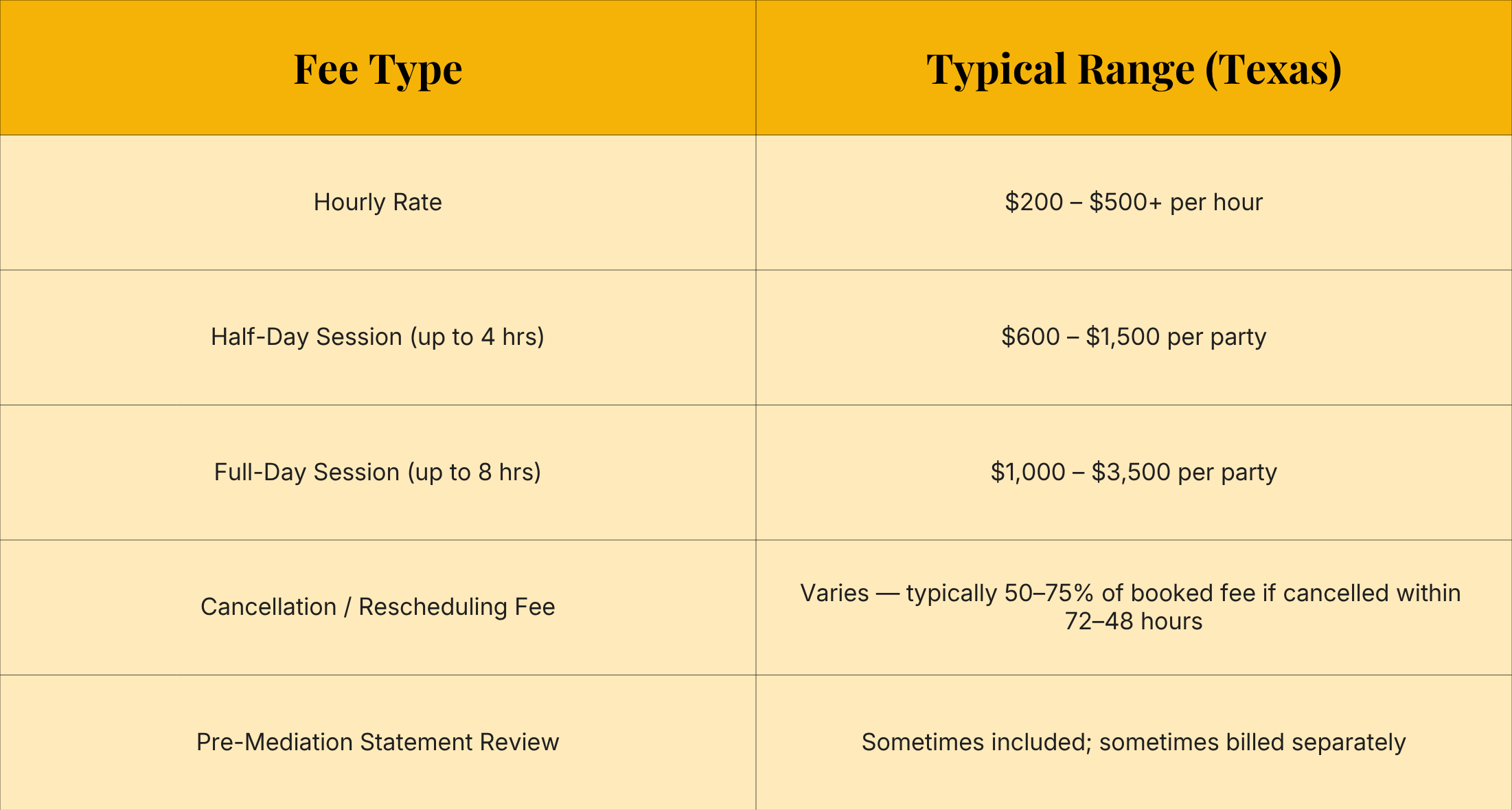
As a general rule, mediator fees are split equally between plaintiff and defendant (50/50). This is the default practice under most local court rules and the parties’ agreed scheduling orders. Different arrangements can be negotiated, but equal splitting is the strong norm
Other Costs to Budget For
Attorney fees for mediation preparation (review of records, drafting mediation statement, strategy sessions)
Travel and lodging if mediation is held at a remote location
Expert or consultant fees if a damages expert participates
Interpreter fees if applicable
Court-Connected Mediation Programs
Some Texas District Courts have court-connected ADR programs that offer reduced-cost or sliding-scale mediation services. These are more common in urban counties (Harris, Dallas, Bexar, Travis). Your attorney can advise whether your county has such a program and whether it is appropriate for your case.
Mediator fees in Texas vary based on experience, reputation, and market. Below are general ranges for Texas District Court personal injury mediations:
Strategic Considerations
For Plaintiffs (Injured Parties)

Build Your Damages Record Before Mediation
Mediation is most productive when the plaintiff has fully documented injuries and damages. Before mediation, ensure you have:
All medical records, bills, and treatment summaries
Wage loss / lost earning capacity evidence
Expert reports (medical, vocational, economic) if the case warrants them
A life care plan for catastrophic injury cases
A well-documented damages case forces the defendant to engage seriously with real numbers rather than speculative minimums.
Know Your Bottom Line — But Keep It Private
Before mediation, your attorney will discuss a realistic settlement range with you. You should have a private minimum figure in mind that accounts for the risks of trial, litigation costs, and the time value of resolution. Do not disclose this number to the mediator unless you have a tactical reason to do so.
Understand the Defense Perspective
A plaintiff who understands why the defendant or insurer values the case as it does is better positioned to negotiate. Ask your attorney: What are their strongest defenses? What comparable verdicts are they relying on? What is the insurance policy limit?
Be Patient
Early defense offers in mediation are rarely final. It is common for defendants to open with a low figure and increase through several rounds of caucus. Do not be discouraged by an opening offer that is far below your expectation.
Plaintiff Checklist Before Mediation Day
Settlement range discussed and agreed upon with your attorney
Authorized your attorney to disclose (or not disclose) specific information to the mediator
Arranged childcare, time off work, and transportation for a full-day session
Confirmed that a person with settlement authority is available for the defendant side
All medical records and bills compiled and organized
Wage loss / employment records provided to your attorney
Pre-existing condition documentation reviewed with counsel
For Defendants / Insurers

Conduct a Thorough Pre-Mediation Evaluation
Defendants and their insurers should complete a rigorous case evaluation before mediation, including assessment of:
Liability exposure and contributory negligence arguments
Damages exposure, including economic and non-economic damages
Comparable jury verdicts in the venue county
Coverage issues and policy limits
Cost of continued litigation vs. cost of settlement
Bring Full Settlement Authority
The single most common reason mediations fail on the defense side is the absence of an adjuster or representative with adequate authority. Ensure that whoever attends — or is reachable by phone — can approve a number at or above a realistic settlement range. Arriving with insufficient authority wastes everyone’s time and damages credibility.
Use the Mediator to Manage Plaintiff Expectations
Experienced defense counsel uses the mediator as a conduit to deliver difficult messages to the plaintiff — the risks of trial, evidentiary weaknesses, comparable defense verdicts — in a less adversarial way than direct confrontation. The mediator’s neutral voice often carries more weight with a plaintiff than the defense attorney’s.
Consider Structured Settlements for High-Value Cases
In catastrophic injury or wrongful death cases, a structured settlement (periodic payments funded by an annuity) can reduce the present-value cost to the defendant while providing the plaintiff with long-term security. Raise this option with your attorney before mediation if the damages exposure is substantial.
Mediation is not a passive exercise. How well-prepared and strategically positioned each party is on mediation day has a direct impact on the outcome.
Defendant / Insurer Checklist Before Mediation Day
Full liability and damages evaluation completed
Reserve reviewed and adjusted to realistic settlement range
Adjuster with binding settlement authority attending or on standby
Defense counsel has prepared a confidential mediation statement
Identified and gathered key evidence to be shared strategically during caucus
Considered structured settlement option for high-value cases
Confirmed venue-specific jury verdict research has been completed
Joint Strategic Principles

Timing of Mediation
When to mediate matters. Mediating too early (before discovery is complete) often leads to impasse because neither side has enough information to assess risk accurately. Mediating too late (on the eve of trial) is expensive and pressured. The optimal window is typically after written discovery, key depositions, and expert designations are complete.
Opening Offers
The opening offer sets the psychological anchor for the negotiation. Plaintiffs should open at a number that is reasonable but leaves room to move downward. Defendants should open at a number that is defensible but leaves room to move upward. Extreme anchors (far too high or far too low) can destroy credibility and cause impasse.
Using the Mediator Strategically
The mediator is a resource. Use private caucuses to share information you want the mediator to convey, to learn how the other side is reasoning, and to test whether certain arguments are landing. Experienced mediators are skilled at probing the other side’s bottom line without breaching confidentiality.
Impasse Is Not Failure
Not every mediation settles, and that is acceptable. An impasse is sometimes the right outcome if the gap between the parties is unbridgeable at the current stage. Mediation often plants seeds that lead to settlement later — even after a failed session. Do not treat an impasse as the end of settlement discussions.
Accomplished. Experienced. Knowledgeable.
Accomplished. Experienced. Knowledgeable.
Attorney Mediation Credentials
Certified Mediator (2020)
Mediation experience since 1992
Extensive background in:
Insurance defense
Products liability defense
Medical malpractice defense
This experience gives attorney Brian C. Steward deep insight into the legal and practical issues involved in complex disputes.
FAQs About Mediation
-
No. Mediation is a voluntary process. You cannot be forced to accept any settlement. If you are not satisfied with the offers made, you may declare an impasse and proceed to trial.
-
Generally yes, with the consent of all parties and the mediator. Discuss this with your attorney in advance. In some courts, family members or other support persons may attend the caucus sessions but not the joint session.
-
Report your concerns to your attorney immediately. Your attorney can address bad-faith participation with the mediator or, if necessary, with the court. Texas courts have authority to sanction parties who fail to attend mediation with a representative of full settlement authority.
-
Yes. Your attorney will be with you throughout the mediation. You should not speak directly with the opposing party or their counsel without your attorney present.
-
The case continues on the court’s docket toward trial. The scheduling order remains in effect. Nothing that was said or offered in mediation can be used against you at trial.
-
Settlement proceeds are typically funded within 30–60 days of the signed settlement agreement and release. Your attorney will manage the disbursement of funds, including payment of medical liens, attorney’s fees, and other obligations, before the net proceeds are distributed to you.
Interested In Mediation?
Take the first step toward resolving your dispute efficiently and respectfully.